
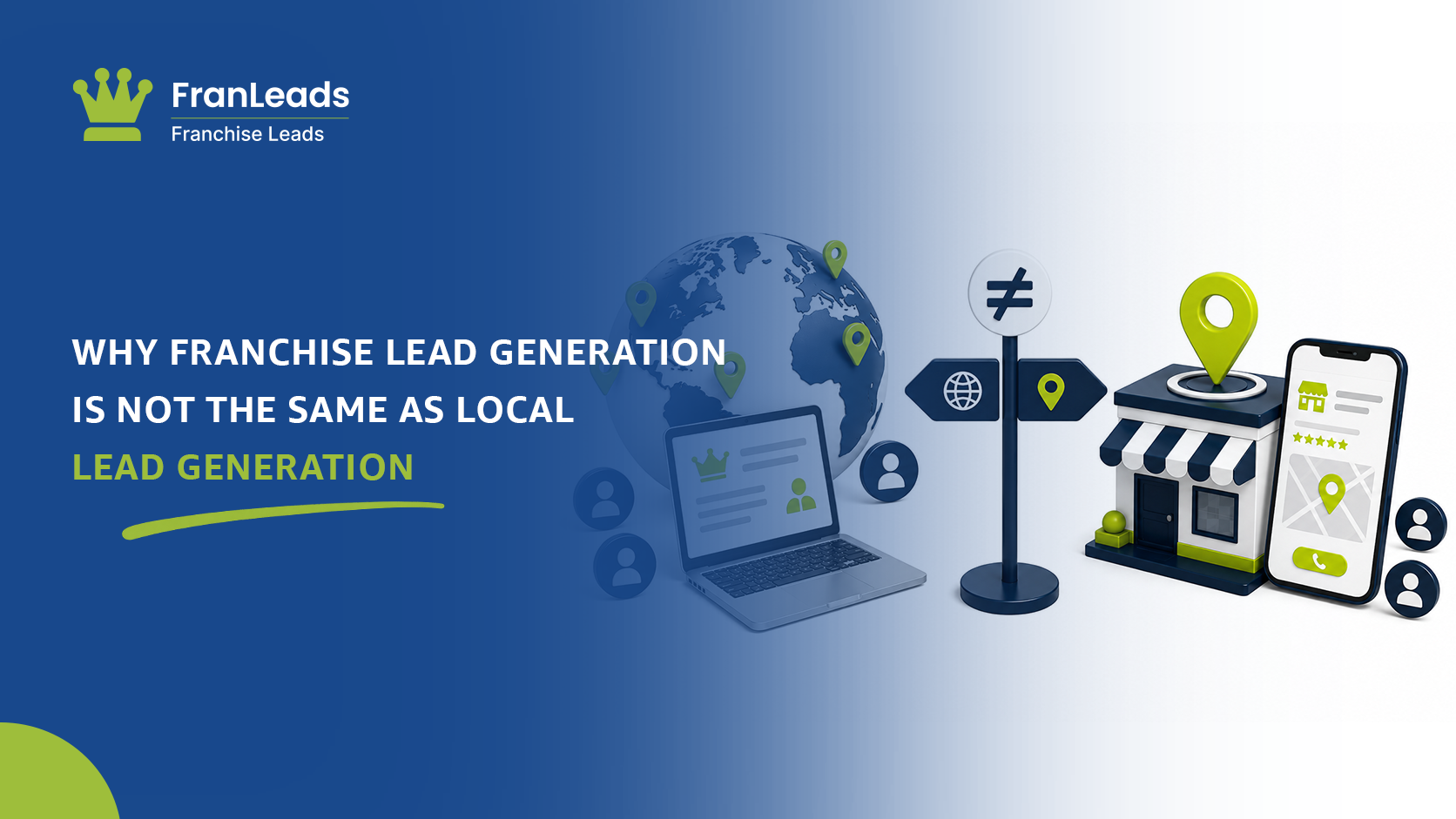
Many franchise brands assume lead generation works the same way across all markets.
If local businesses can generate leads through ads, SEO, and landing pages, franchise brands assume the same tactics apply to recruiting franchisees.
They don’t.
The differences between franchise lead generation versus local marketing go far beyond the type of buyer. They involve different decision timelines, risk profiles and conversion goals. Treating them the same is one of the fastest ways to inflate CPL while lowering conversion.
Here’s why they’re fundamentally different, and what that means for your strategy.
Table of Contents
- You’re Selling Ownership, Not a Service
- The Buyer Journey Is Much Longer
- Lead Quality Matters More Than Lead Volume
- Messaging Must Shift From Benefits to Economics
- Speed-to-Lead Still Matters, But Follow-Up Matters More
- SEO Strategy Is Completely Different
- Sales Skills Are Different
- Metrics That Matter Are Different
1. You’re Selling Ownership, Not a Service
Local lead generation targets people looking to buy now.
Franchise lead generation targets people considering:
- major financial commitments
- career changes
- long-term investments
- lifestyle shifts
The emotional and financial stakes are far higher.
A local lead converts in days.
A franchise lead may convert in months.
2. The Buyer Journey Is Much Longer

Local customers usually:
- identify a need
- search
- compare options
- book
Franchise buyers go through:
- awareness
- financial evaluation
- family discussions
- market research
- validation calls
- risk assessment
That longer journey requires structured nurturing, not just ad clicks.
3. Lead Quality Matters More Than Lead Volume
Local businesses can survive with a combination of good and bad leads.
Franchise brands can’t.
Low-quality franchise leads:
- drain sales time
- inflate follow-up costs
- reduce team morale
- distort marketing metrics
Franchise funnels must prioritize:
- financial qualification
- timeline clarity
- territory alignment
Filtering early improves efficiency later.
4. Messaging Must Shift From Benefits to Economics
Ready to Scale Your Franchise Brand?
Every lead that reaches your inbox has already been vetted and matched to your territory, so you only speak with serious buyers.
Local lead generation focuses on:
- convenience
- price
- features
- urgency
Franchise lead generation must focus on:
- investment range
- ROI expectations
- territory potential
- support systems
- risk mitigation
You are not just selling a product; you’re selling a business model.
5. Speed-to-Lead Still Matters, But Follow-Up Matters More
Local leads often convert quickly if contacted fast.
Franchise leads require:
- immediate response
- structured follow-up
- multi-touch nurturing
- educational content
Deals are rarely won in one conversation.
Consistency beats urgency alone.
6. SEO Strategy Is Completely Different
Local SEO focuses on:
- service keywords
- geographic searches
- immediate intent
Franchise SEO must target:
- ownership research queries
- investment comparisons
- territory searches
- earnings potential questions
Authority content converts better than promotional pages.
7. Sales Skills Are Different
Local sales teams:
- handle transactional conversations
- solve immediate problems
- close quickly
Franchise development teams:
- guide long decision processes
- build trust over time
- address financial and emotional concerns
- structure complex deals
This requires a completely different funnel approach.
8. Metrics That Matter Are Different
Local businesses optimize for:
- cost per lead
- booking rate
- short-term ROI
Franchise brands should optimize for:
- cost per qualified lead
- call-to-LOI rate
- LOI-to-award rate
- time to territory sale
Short-term metrics rarely predict franchise success.
FAQ
Franchise lead generation targets potential business owners, while local lead generation typically targets customers looking to purchase a product or service.
Buying a franchise is a significant investment and lifestyle decision that typically requires more research, qualification, education, and follow-up.
Quality franchise leads have a greater chance of becoming viable prospects because they fit the financial, time, and territory requirements of the franchise opportunity.
Local SEO focuses on geographic and service-based searches, while franchise SEO targets people researching franchise ownership opportunities, costs, territories, and business models.
Franchise brands should track metrics such as cost per qualified lead, LOI-to-award conversion rate, discovery call rates, and time-to-territory sale to evaluate lead generation performance.
Conclusion
Franchise lead generation isn’t local marketing scaled up.
It’s a different discipline entirely.
Brands that succeed understand:
- the buyer journey is longer
- qualification is essential
- nurturing drives conversions
- messaging must address economics
- authority builds trust
Treat franchise recruitment like customer acquisition, and you’ll attract curiosity.
Treat it like investment marketing, and you’ll attract owners.
Ready to Scale Your Franchise Brand?
Every lead that reaches your inbox has already been vetted and matched to your territory, so you only speak with serious buyers.

