
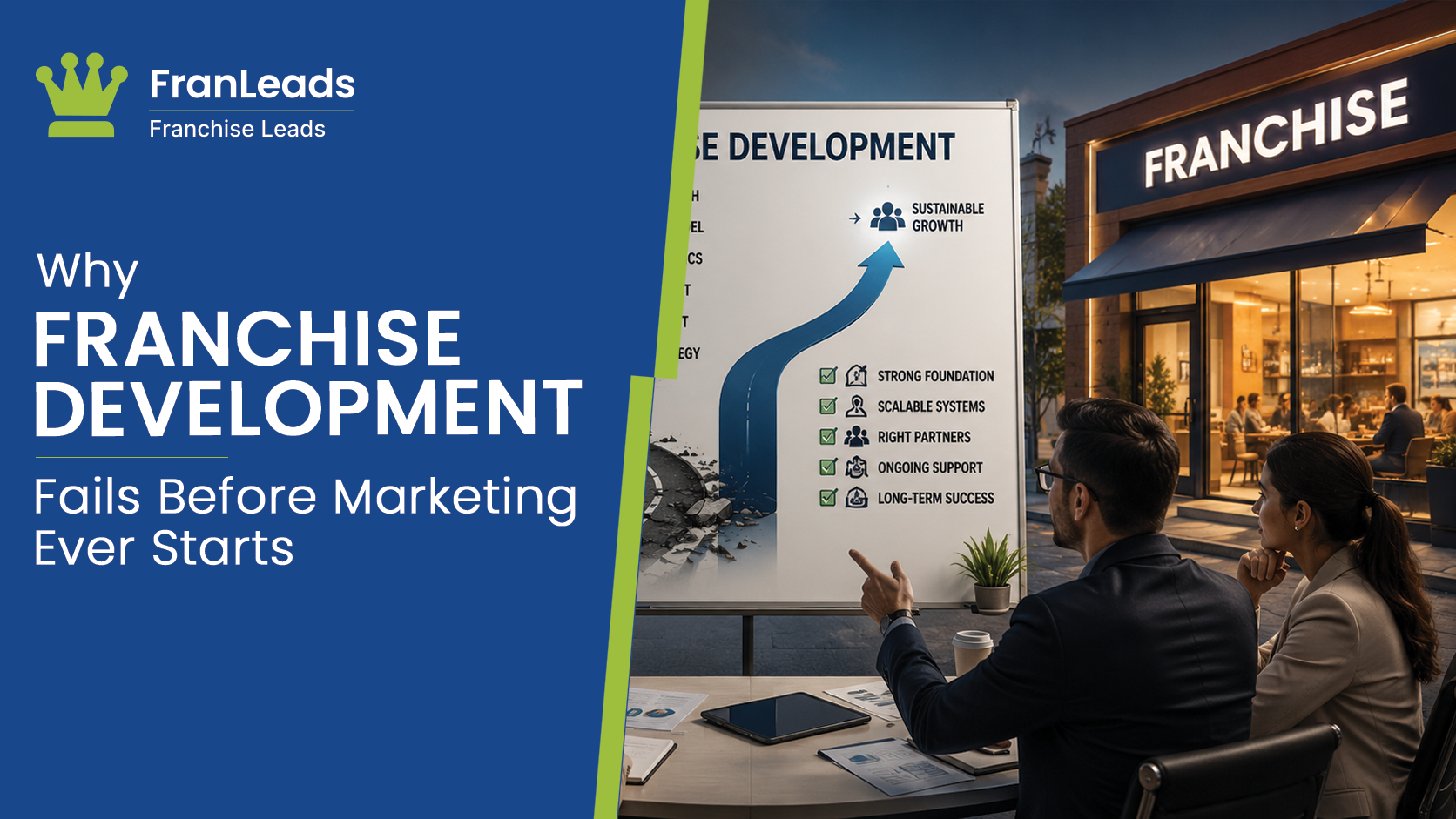
Most brands react by looking at marketing when franchise growth comes to a halt.
They blame:
- lead volume
- ad performance
- CPL
- traffic quality
Yet the real issue often preceded even a single ad.
Marketing doesn’t crash franchise development.
Most of the time, it ends in failure because the business is not ready to scale at that point in time.
Table of Contents
- Marketing Goes So Far — It Cannot Raise A Weak Foundation
- Confused Franchise Positioning
- Buyers Are Doubtful Due To Weak Unit Economics
- No Defined Territory Strategy
- The Brand Has Not Yet Scaled
- Leadership Often Underestimates Development
- Marketing Magnifies Existing Problems
- What Strong Franchise Brands Do First
- Pipeline Stages for Franchise Sales
- The Real Question
Marketing Goes So Far — It Cannot Raise A Weak Foundation
More leads are the solution to many growth challenges for emerging franchise brands.
However, if the underlying system is flimsy, then more leads only reveal more sanitation issues.
Marketing can generate attention.
It cannot fix:
- poor unit economics
- unclear positioning
- weak support systems
- inconsistent operations
The eventual by-product of those problems is in franchise sales discussions.
Confused Franchise Positioning
One of the largest early problems is the absence of your position.
Many brands struggle to answer:
Why this franchise?
Why this category?
Why now?
What does an investor get here that they cannot find elsewhere?
Lead gen becomes infinitely more challenging if the opportunity isn’t clearly differentiated.
Buyers Are Doubtful Due To Weak Unit Economics
Sophisticated franchise buyers eventually ask:
“Do the numbers work?”
If the unit-level economics are uncertain, contradictory, or unconfirmed, marketing is pointless.
Buyers want confidence in:
- profitability potential
- payback timelines
- scalability
Without those answers, sales stall.
No Defined Territory Strategy
Numerous brands enter into franchise sales without a strategic plan to develop territories.
Questions buyers often ask include:
Which markets are available?
How large are territories?
What exclusivity exists?
Please talk about the long-term expansion plan.
Quick tip: Without clear territory structure, buyers have a hard time with growth visualization.
However, it does not identify franchisee support systems.
Franchise buyers are not simply buying a company.
Buyers notice if support processes are weak, and they notice fast.
Common issues include:
- limited onboarding
- unclear training
- weak operational documentation
- inconsistent support expectations
Confidence erodes in a system that doesn’t feel complete.
The Brand Has Not Yet Scaled
Ready to Scale Your Franchise Brand?
Every lead that reaches your inbox has already been vetted and matched to your territory, so you only speak with serious buyers.
Just because one location has been successful does not mean you have a franchise system.
Before scaling, brands must prove:
- operational consistency
- repeatable processes
- market adaptability
- franchisee success potential
The heavy reliance on either one founder or one location makes it difficult to expand.
Leadership Often Underestimates Development
Franchise development is an area all on its own.
Many brands assume:
- Awesome biz + marketing = franchise growth
In reality, franchise development requires:
- sales systems
- territory planning
- support infrastructure
- investor positioning
Without these, growth becomes unpredictable. Avoiding common franchise growth strategy mistakes is essential for building a development system that can support sustainable expansion.
Marketing Magnifies Existing Problems
Strong marketing brings visibility.
But visibility can expose weaknesses.
If:
- leads aren’t converted
- buyers lose confidence
- discovery calls underperform
The ad campaign is rarely the problem.
Typically, this is further up the development chain.
What Strong Franchise Brands Do First

Successful brands emphasize these aspects before scaling aggressively. This approach also helps them avoid franchise growth strategy mistakes that can make expansion harder later.
- unit economics
- operational systems
- territory strategy
- franchisee support
- positioning clarity
They do this only after they invest more into marketing.
The Real Question
Before asking:
How do we acquire additional franchise leads?
Ask:
Are we ready for the leads that are already in our hands?
That question is what often identifies where the true bottleneck exists.
FAQ
Typical issues are weak unit economics, unclear positioning, territory planning issues, and lack of proper franchisee support systems.
If a business does not have the operational systems, capital, positioning, or support required to scale, the franchise development process can fail.
Strengthening operations, validating unit economics, defining territories, and developing scalable support systems can help franchisors reduce errors.
A clear territory strategy helps buyers understand market potential while giving franchisors a structured path for expansion.
No, brands should establish strong operations, support, positioning, and economics before aggressively increasing franchise lead generation.
Conclusion
Marketing is important.
However, it is not the starting point.
The strongest franchise brands build:
- repeatable operations
- scalable support systems
- clear territory strategies
- strong investor positioning
before they aggressively pursue growth.
Because in franchise development:
Marketing creates attention.
Systems create expansion.
Ready to Scale Your Franchise Brand?
Every lead that reaches your inbox has already been vetted and matched to your territory, so you only speak with serious buyers.

