
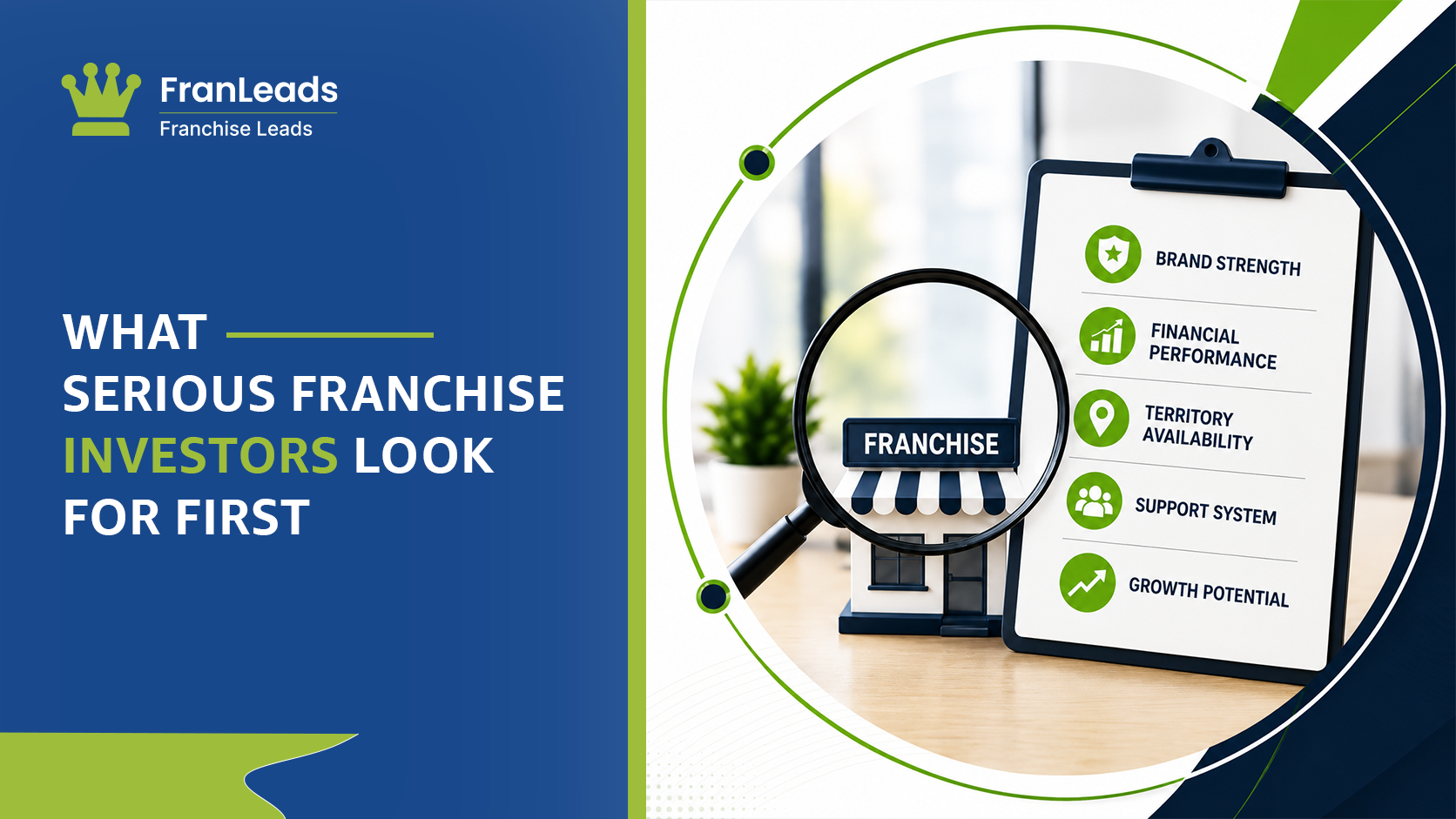
Franchise marketing often highlights lifestyle, freedom, and growth potential.
But serious franchise investors don’t start there.
Before they care about the brand story, unit count, or testimonials, experienced investors run a much quieter filter. They are trying to answer one core question:
“Is this a scalable, de-risked business or just a well-marketed opportunity?”
Here’s what serious franchise investors actually look for first, and why many brands lose them early without realizing it.
Table of Contents
1. Unit Economics That Work Without Optimism

The very first filter is simple:
Does unit economics work on paper without heroic assumptions?
Investors look for:
- contribution margin after real operating costs
- realistic labor assumptions
- stable pricing power
- predictable demand drivers
- breakeven timelines that make sense
If profitability depends on:
- perfect execution
- unusually cheap labor
- aggressive growth assumptions
- constant owner involvement
experienced investors quietly move on.
They want models that work normally, not exceptionally.
2. Transferability (Can Someone Else Run This?)
Investors are not buying your hustle.
They’re buying something that can survive a handoff.
Early questions include:
- Who runs day-to-day operations?
- What breaks if the owner steps away?
- How standardized are systems and training?
- How quickly can a new operator become functional?
Owner-dependent businesses feel risky.
System-dependent businesses feel investable.
3. Territory Logic and Market Control
Sophisticated franchise investors think in markets, not units.
They want clarity on:
- territory size and exclusivity
- saturation limits
- expansion runway
- rules for density and overlap
A franchise that can’t clearly explain territory strategy feels underdeveloped, even if individual units perform well.
Territory clarity signals long-term thinking.
Ready to Scale Your Franchise Brand?
Every lead that reaches your inbox has already been vetted and matched to your territory, so you only speak with serious buyers.
4. Speed and Professionalism in the Sales Process
How a brand sells is how investors assume it operates.
Investors notice:
- speed-to-lead
- quality of follow-up
- clarity of communication
- organization of materials
- confidence (not pressure)
Slow, messy, or reactive sales processes signal weak execution.
Fast, structured, and calm processes build trust immediately.
5. Evidence, Not Promises
Serious investors don’t respond to hype.
They want:
- performance ranges, not best-case examples
- real franchisee stories
- validation calls
- retention metrics
- documented outcomes
They don’t expect perfection.
They expect honesty and control.
Over-selling is a red flag.
6. Capital Fit and Return Profile
Investors quickly assess:
- total capital required
- working capital needs
- cash-on-cash potential
- timeline to stability
- downside protection
If the return profile doesn’t justify the effort and risk, the conversation ends, even if the brand is exciting.
7. Support Infrastructure (Not Just “Support Promises”)
Every brand claims to offer support.
Investors look for:
- onboarding timelines
- training depth
- marketing systems
- hiring support
- ongoing performance tracking
They want to see how support is delivered, not just that it exists.
8. Exit Optionality
Even on day one, serious investors think about the exit.
They ask:
- Who would buy this later?
- Does this scale into a portfolio?
- Are there consolidators in the space?
- Does this support multi-unit or territory expansion?
If there’s no clear path to exit optionality, risk feels one-sided.
FAQ
Serious franchise investors typically begin by evaluating unit economics, profitability potential, and whether the business model can operate successfully without excessive owner involvement.
Investors value businesses that can operate through established systems and trained operators rather than depending entirely on the owner. Strong transferability can make the franchise more scalable and attractive as an investment.
Territory strategy is important because investors evaluate the franchise’s growth potential, territory exclusivity, market demand, and opportunities for expansion within available markets.
Franchise investors typically look for realistic performance data, franchisee experiences, retention metrics, and documented business outcomes rather than relying solely on marketing claims.
Clear exit options can help reduce investment risk and indicate whether the franchise has long-term growth potential as part of a larger portfolio or through a future sale.
Conclusion
Serious franchise investors don’t start with the brand.
They start with:
- economics
- transferability
- territory logic
- execution quality
- risk control
The franchises that win aren’t the loudest.
They’re the clearest, most structured, and most realistic about how money is made and protected.
If your franchise can pass these first filters, the brand story actually gets heard.
Ready to Scale Your Franchise Brand?
Every lead that reaches your inbox has already been vetted and matched to your territory, so you only speak with serious buyers.

