
Most franchise brands believe their problem is lead volume.
In reality, the problem is funnel breakdown.
Clicks turn into leads.
Leads stall.
Sales teams chase ghosts.
And territories sit unawarded.
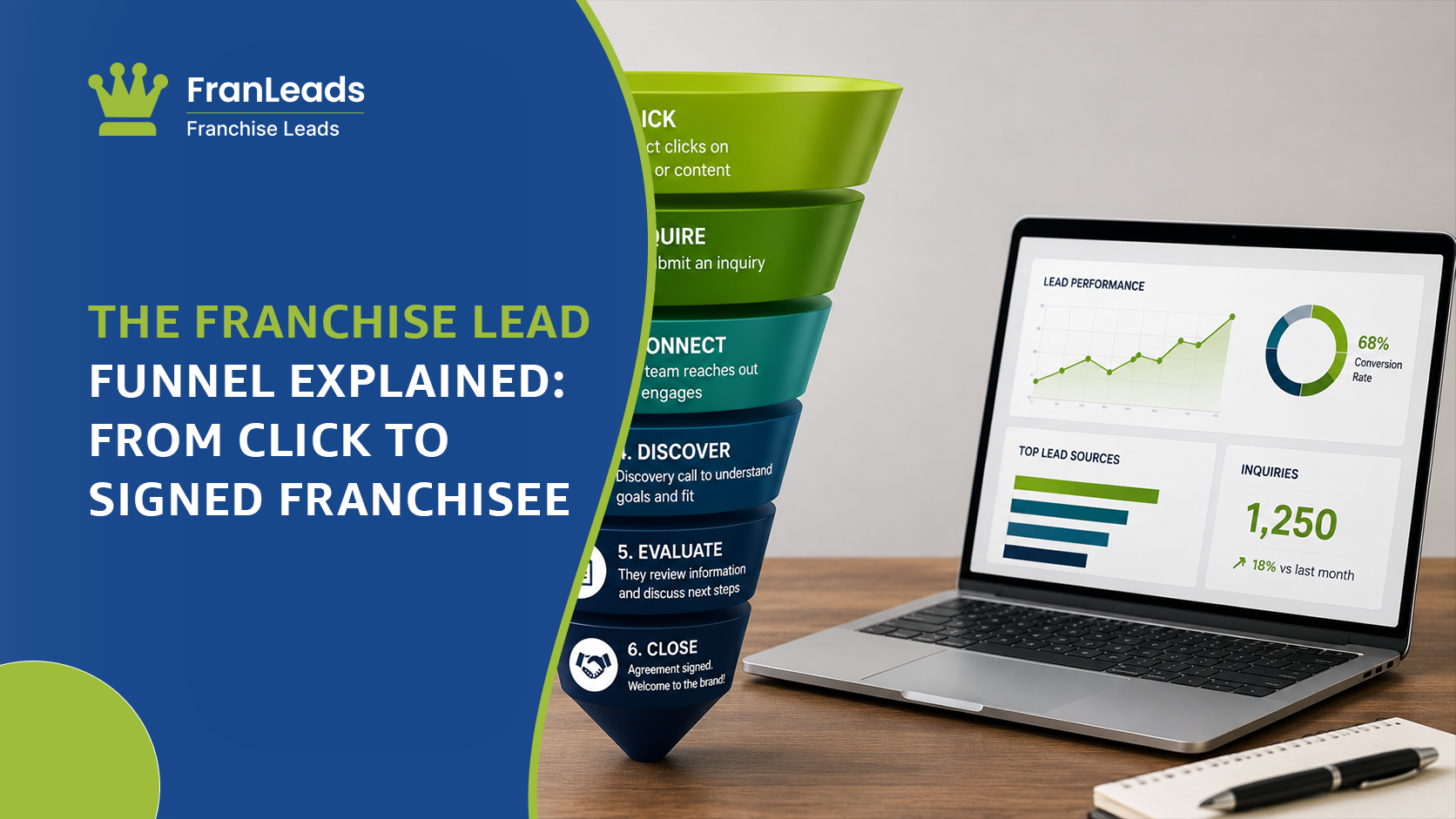
The brands that scale franchise sales don’t rely on luck, they engineer a tight, disciplined lead funnel from first click to signed franchisee.
Here’s how the franchise lead funnel actually works, where it breaks, and what winning brands do differently.
Table of Contents
- Stage 1: The Click (Intent Matters More Than Traffic)
- Stage 2: The Lead (Qualification Starts Immediately)
- Stage 3: Speed-to-Lead (The Make-or-Break Moment)
- Stage 4: Discovery Call (Fit Over Pitch)
- Stage 5: Validation & Education
- Stage 6: Territory & Investment Alignment
- Stage 7: LOI & Commitment
- Stage 8: Awarded Franchisee
- Where Most Franchise Funnels Fail
Stage 1: The Click (Intent Matters More Than Traffic)
Not all clicks are equal.
Strong franchise funnels start by attracting:
- financially qualified prospects
- realistic timelines
- buyers researching ownership, not “curious browsers”
High-performing brands focus on:
- investment-qualified messaging
- territory-based offers
- clear positioning (not hype)
If the click is wrong, everything downstream suffers.
Stage 2: The Lead (Qualification Starts Immediately)
The lead form is not a formality, it’s a filter.
Top brands avoid:
- “Download the FDD”
- vague “learn more” offers
Instead, they use:
- territory availability checks
- investment range confirmation
- timeline-to-launch questions
This immediately improves lead quality and sales efficiency.
Ready to Scale Your Franchise Brand?
Every lead that reaches your inbox has already been vetted and matched to your territory, so you only speak with serious buyers.
Stage 3: Speed-to-Lead (The Make-or-Break Moment)

This is where most funnels collapse.
Data consistently shows:
- leads contacted within 5 minutes convert dramatically higher
- delays of 30–60 minutes crush intent
- hours or days later = dead lead
Winning funnels include:
- instant SMS + email
- automated calendar booking
- live call routing
- strict response SLAs
Speed doesn’t feel aggressive to buyers, it feels professional.
Stage 4: Discovery Call (Fit Over Pitch)
The first call is not a sales pitch.
It’s a fit assessment.
Strong discovery calls:
- confirm financial readiness
- understand buyer goals
- align territory expectations
- qualify timeline and commitment
When done right, this reduces objections later and shortens the sales cycle.
Stage 5: Validation & Education
This is where trust is built.
Buyers want:
- real unit economics
- franchisee conversations
- realistic timelines
- transparency on challenges
Brands that over-sell lose credibility here.
Brands that guide buyers calmly move faster.
Stage 6: Territory & Investment Alignment
Serious buyers don’t buy “a franchise.”
They buy:
- a specific territory
- a defined market
- a clear capital plan
This stage focuses on:
- territory mapping
- exclusivity rules
- growth runway
- multi-unit or expansion paths
Clarity here prevents late-stage friction.
Stage 7: LOI & Commitment
By the time paperwork appears:
- objections should already be handled
- expectations should be aligned
- financial fit should be clear
LOIs convert best when they confirm decisions, not force them.
Stage 8: Awarded Franchisee
The funnel doesn’t end at signature.
Strong brands ensure:
- clean handoff to on boarding
- clear launch timelines
- early operational support
This protects brand reputation and future referrals.
Where Most Franchise Funnels Fail
A franchise sales funnel breakdown can happen at any stage, from poor qualification and slow follow-up to unclear territory expectations.
Common breakdowns include:
- poor qualification upfront
- slow response times
- unstructured sales calls
- over-selling instead of guiding
- unclear territory logic
- chasing volume instead of fit
Each leak compounds.
FAQ
A franchise lead funnel guides prospects from their initial interaction with a franchise brand through qualification, discovery, validation, territory alignment, and ultimately becoming a franchisee.
The key stages include lead generation, qualification, discovery calls, validation, territory alignment, and the franchise award.
Common problems include poor qualification, slow follow-up, weak discovery calls, unclear territory details, and focusing on lead volume rather than lead quality.
Brands can improve their funnel through better qualification, faster response times, organized discovery calls, accurate information, and clear next steps throughout the sales process.
Quick follow-up helps keep prospects engaged when their interest is highest, increasing the opportunity for meaningful conversations and improving the chances of conversion.
Conclusion
Franchise growth isn’t about generating more leads.
It’s about building a funnel where:
- the right prospects enter
- speed protects intent
- structure builds trust
- clarity drives commitment
From click to signed franchisee, every stage must reduce risk for both buyer and brand.
The franchises that scale don’t guess.
They engineer the funnel.
Ready to Scale Your Franchise Brand?
Every lead that reaches your inbox has already been vetted and matched to your territory, so you only speak with serious buyers.

